

Student Highlights: Logan Opsal
— MEET LOGAN —
Class: Senior
Major: Wildlife and Fisheries Biology and Management
Logan Opsal is a lifelong Wyoming resident who now resides in Laramie, Wyoming. He grew up an hour away from Laramie in the capital city of Cheyenne. Like most kids who were raised on the front range of the Rocky Mountains, Logan developed a affinity for the mountains and great outdoors by partaking in various recreational activities including camping, climbing, hunting, fishing, and backpacking. His strong passion for the outdoors eventually led him to pursue a bachelor’s degree in Wildlife and Fisheries Biology and Management at the University of Wyoming, where he has been an active member of Dr. William Fetzer’s fish ecology and management lab since his first semester in 2021.
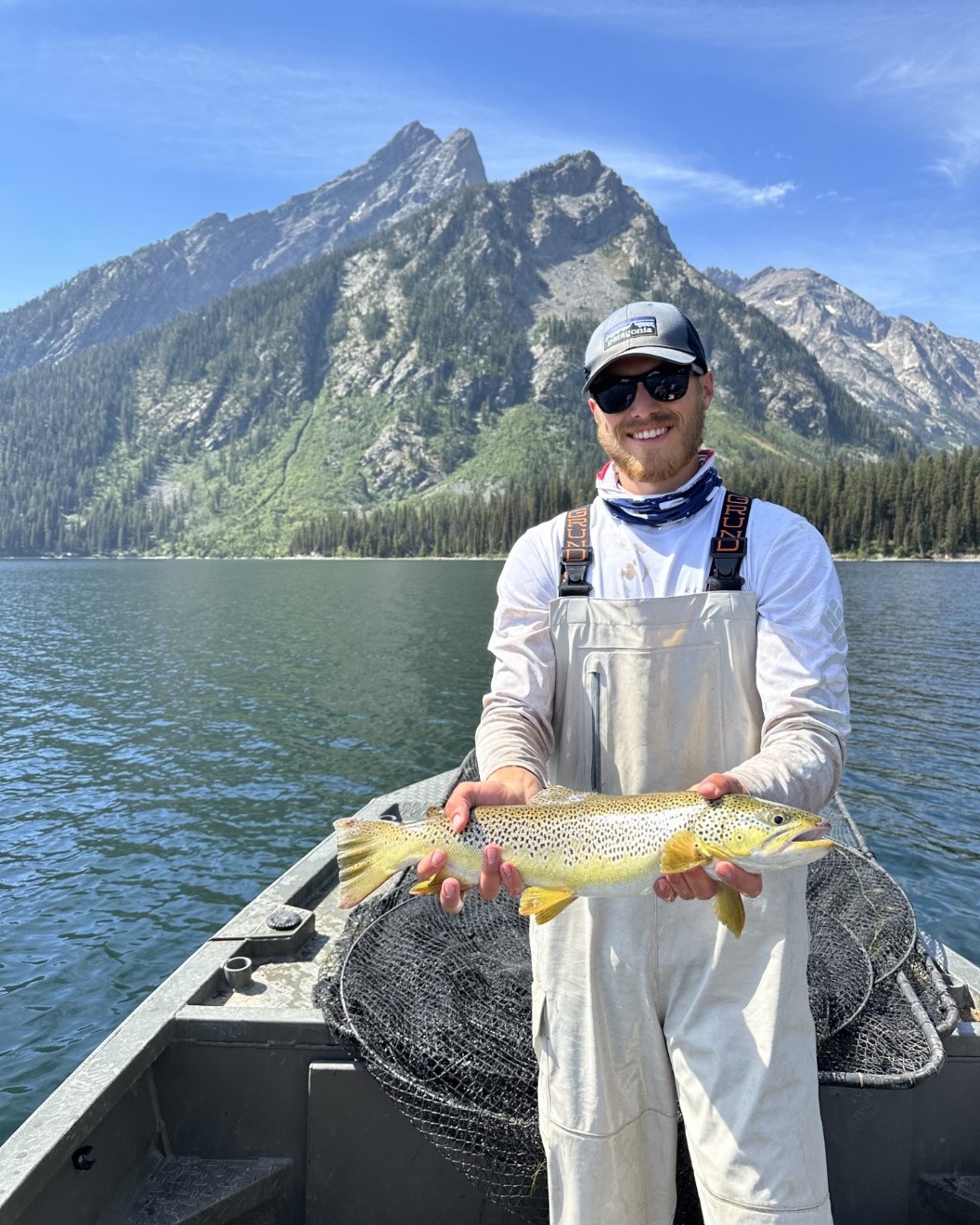
During his time in the lab, Logan has worked on a variety of collaborative projects with multiple agencies across the state both as a technician and researcher. In his free time, Logan still enjoys all his outdoor recreational hobbies and likes to spend time with his wife, Basia, and their two dogs, Oswald and Khaleesi.
— LOGAN’S RESEARCH —
Logan’s current undergraduate research focuses on evaluating how five stocked trout and salmon species (salmonids) from four Wyoming reservoirs share food and habitat resources. Understanding shared resource use of coexisting species is important for identifying potential competition between species and individuals and will help biologists and managers make decisions that could improve fish stocking success and overall fishery health.
To quantify resource use, Logan will be analyzing stable isotopes in muscle tissues collected from individual fish to identify nearshore versus offshore feeding, determine how high in the food chain an individual is feeding at (trophic position), and distinguish between recently stocked fish and fish that have naturalized in the reservoir. More specifically, Logan plans to use stable isotopes to: (1) quantify and compare resource use and trophic position among and within salmonid species; (2) identify potential competition for shared resources within and among stocked and naturalized salmonid species and populations; and (3) Identify potential shifts in resource use and trophic position as fish grow larger.
ABOUT STUDENT HIGHLIGHTS
Every year, we award fellowships to graduate and undergraduate students attending the University of Wyoming or Wyoming’s community colleges in order to provide them with funding to engage in real-world research opportunities. Occasionally, we feature one of these students and their research on this blog. For more information about our student fellowships, visit our College Programs page.